 MRT View Factors - [source code]
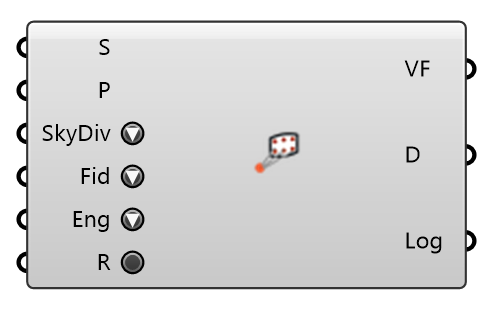
Assembles tagged surfaces + sensors into a radiation model, builds the sky dome, and solves probe-to-polygon view factors. Feed the VF Model to SurfaceTemp (EnergyPlus) and/or MRT Solve. The sweep is the expensive part of an MRT run — solving it once here lets the downstream stages re-run without repeating it. Method: Dogan, Kastner & Mermelstein (2021), Building and Environment 196:107762, doi:10.1016/j.buildenv.2021.107762.
Input
| Name | Nickname | Description | Type |
|---|---|---|---|
| Surfaces | S | Tagged radiation surfaces (MRT Surface). Branches are flattened — everything wired here forms one scene. | Generic Data |
| Sensors | P | Sensor probes (MRT Sensors). Branches are flattened. | Generic Data |
| Sky Dome Subdivisions | SkyDiv | Resolution of the internal MRT sky hemisphere, as a SUBDIVISION LEVEL: the dome has 6 x 4^level faces, half of them above the horizon. Higher levels smooth the view factors but cost time on every probe; 5 (3072 patches) is ample for MRT. | Text |
| Fidelity | Fid | How much of the occlusion raycasting to spend. Balanced (default): polygons whose view factor is below 5e-5 are assumed visible instead of raycast — each such polygon can shift the normalized result by less than that, and the sweep runs several times faster. Fast: same idea at 2e-4, and the sky dome is capped at 768 patches (level 4) — the dome only refines the probe-specific sky view fraction, which 768 patches already pin to ±0.02 of the 3072-patch answer. Quick iteration on big models. Reference: every contribution above the 1e-5 floor is raycast (the original behavior). Use for the final run when publishing numbers. Sky patches are always raycast at every fidelity. | Text |
| Engine | Eng | Who does the heavy lifting of the sweep: the occlusion rays (and the raycast shortwave in MRT Solve) AND the view-factor geometry of every probe x polygon pair (the cos·area/r² term) ahead of them. Auto: rays on Embree when its natives load, else the OpenCL GPU when a device answers, else the managed BVH; geometry on the GPU when one answers, else the CPU. GPU: rays and geometry on the OpenCL GPU even where Embree loads, which pays off on the sweep's large ray batches; a fallback to the CPU is reported in the log and as a warning, never silent. Embree: Embree rays, geometry on the CPU. BVH: the managed BVH and CPU geometry — the same answer on every machine. GPU geometry is float; measured within 2e-6 per view factor of the CPU's at Reference fidelity. | Text |
| Run | R | Solve the view factors. | Boolean |
Output
| Name | Nickname | Description | Type |
|---|---|---|---|
| VF Model | VF | The assembled radiation model with solved view factors. Feed to SurfaceTemp (EnergyPlus) and MRT Solve. | Generic Data |
| Sky Dome | D | The sky dome mesh (preview). | Mesh |
| Log | The run's full log, one line per item — stages, sizes, engine choice, timings. | Text |