 Sun Vectors - [source code]
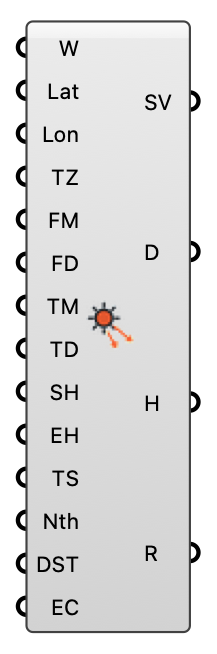
Sun positions for a period at a chosen time step (6-minute and finer), from site and clock rather than from an EPW's hourly rows.
Input
| Name | Nickname | Description | Type |
|---|---|---|---|
| Weather | W | Optional weather object; Latitude, Longitude and Time Zone are read from it when connected, and override the numeric inputs below. | Generic Data |
| Latitude | Lat | Degrees north. | Number |
| Longitude | Lon | Degrees east. | Number |
| Time Zone | TZ | Hours ahead of UTC, STANDARD time — not the summer offset. | Number |
| From Month | FM | Start month [1-12]. | Integer |
| From Day | FD | Start day [1-31]. | Integer |
| To Month | TM | End month [1-12], inclusive. | Integer |
| To Day | TD | End day [1-31], inclusive. | Integer |
| Start Hour | SH | First hour of day [0-23]. | Integer |
| End Hour | EH | Last hour of day, exclusive [1-24]. | Integer |
| Timestep | TS | Samples per hour. 1 = hourly (the old behaviour), 10 = a 6-minute step. Cost is linear in this: 10x the samples really is 10x the rays. | Integer |
| North | Nth | Counter-clockwise degrees from the model's +Y axis to true north (Ladybug's convention). | Number |
| Daylight Saving | DST | Treat the hour window as summer clock time. EPW data is standard time, so leave this off when matching a weather file. | Boolean |
| Elevation Cutoff | EC | Drop samples at or below this solar elevation. 0 keeps everything above the horizon; raise it to ignore the grazing sun that refraction makes unreliable. | Number |
Output
| Name | Nickname | Description | Type |
|---|---|---|---|
| Sun Vectors | SV | Sun samples — direction, the hours each represents, and the instant sampled. Feeds Sun Path. The analysis components read a weather record directly instead. | Generic Data |
| Directions | D | The same directions as plain vectors, for drawing. | Vector |
| Hours | H | Hours each sample represents. Sums to the daylight in the period. | Number |
| Report | R | Sample count, daylight hours and the step used. | Text |